Child Advocacy Collaboration: How to Stop Stalling Progress
-
Why does child advocacy work sometimes feel like high school? New qualitative research from Forthright Advising reveals a hidden barrier in the nonprofit sector: frenemy dynamics. Despite sharing identical goals like funding universal preschool, competing organizations often run fragmented campaigns and stall real progress over brand visibility and donor dollars. Based on our Frenemies + Jargon report, this guide offers a two-step framework to replace superficial alignment with authentic child advocacy collaboration. Learn how to define your team's internal messaging must-haves, identify where to make smart strategic compromises and share vital resources to achieve systemic policy wins for youth and families.
When we launched our research process – the one that led to our new Frenemies + Jargon: Breaking the Habits That Stall Child and Family Advocacy report – I had suspicions about what we’d find.
I figured we’d hear that advocacy is hard, that AI’s a pain, that nonprofit funding is a bit of a dumpster fire right now.
What I didn’t expect?
That our interviewees would say that sometimes, working in advocacy feels like returning to high school. (And not the good parts.)
We heard that as a field, we’re often fake friends. Let’s break down what we heard and what we can do about it.

What did nonprofit and education leaders say about fake friendships in advocacy?
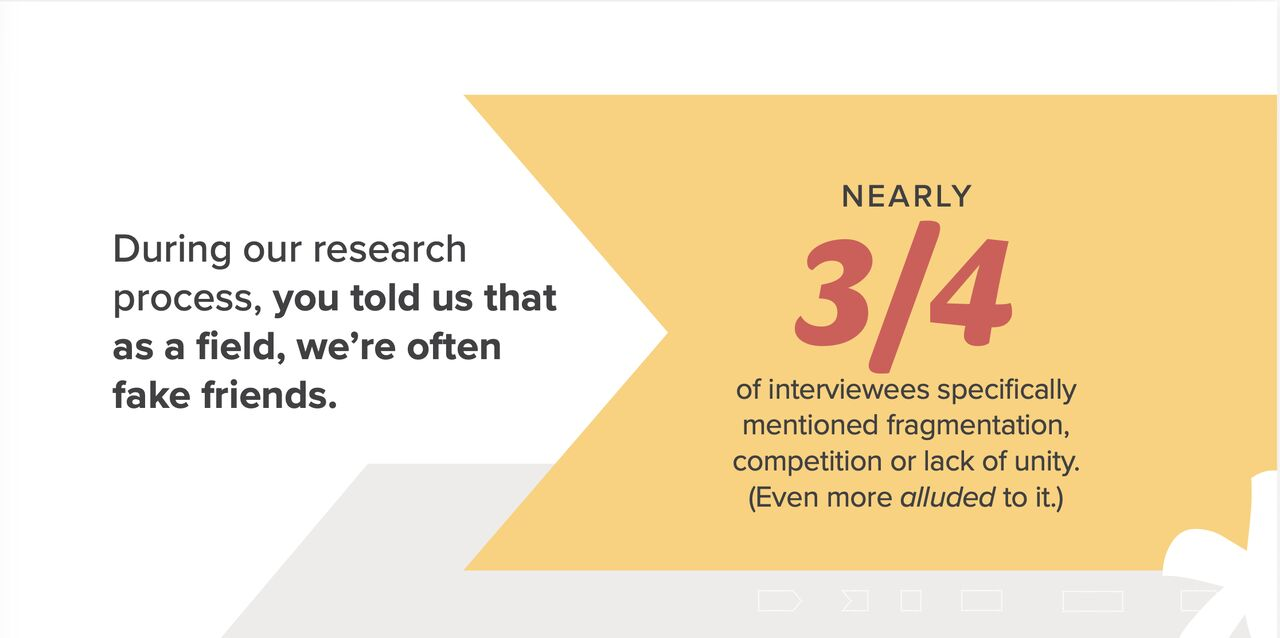
Nearly 75 percent of interviewees specifically mentioned fragmentation, competition or lack of unity. (Even more alluded to it.)
We don’t collaborate well. We’re constantly competing with one another – for brand awareness, for funding, for the detailed approach *we* think is best. We’re worried about losing our competitive advantage and don’t want to “cede critical points.”
We have an illusion of kumbaya. Even when we’re in coalition or community, we turn our backs on one another when it comes to certain issues or when our priorities are slightly different.
Many of our friends fighting for equity feel abandoned. We heard that many leaders had no choice but to step back from their racial equity priorities. Our interviewees shared the heavy weight of these choices, which (unintentionally) erased years of progress.
Our opposition is better at compromise than we are. They’ve been loyally on the same page, using the same narrative for decades… and it shows.
Could you share an example of fake friendships in action?
So what does this look like in action?
Two organizations – the Tiny Humans Reading Nonprofit and Big Brains for Babies Collective – both work in Walkerville. They have similar goals – they both want more funding for universal preschool. But instead of joining forces, they run separate campaigns.
They both want their logo (and only their logo) on a press release about the win. They compete for the same donor dollars and same meeting times with the mayor. Because they can’t agree on who gets the win, city councilmembers are confused by the conflicting asks. The funding for kids ends up delayed for another year.
Sound familiar?
How do we become better friends to one another?
Data shows that working closely together improves the well-being of youth and families. It’s time to make smart compromises in service of the bigger picture.
1️⃣Step 1: Start with your internal team.
Define your messaging must-haves. Identify when your choices are just preferences or nice-to-haves. In that conversation, question WHY you talk about your work in a certain way. Here are some easy-to-update, template questions you can ask:
How did we create the messaging we use today?
Are we happy with the language we use?
Why do we describe our mission the way we do?
Is it because we’ve always said it that way?
Or, is it because different phrasing would betray our community?
What do we HAVE to include?
Where can we be flexible with our messaging?
How is our messaging meeting the current moment?
Determine your biggest focus areas. Agree on your absolute biggest goals, right now. For example, this could be getting a bond campaign passed that gets a mental health professional into every school in your district. Then, think through how you can collaborate to make your goals a reality.
Consider what you win if you compromise. This stands true for both messaging and the campaigns you sign on to. In many cases, you’ll find that the wins are way greater than the losses.
2️⃣Step 2: Go make *real* friends.
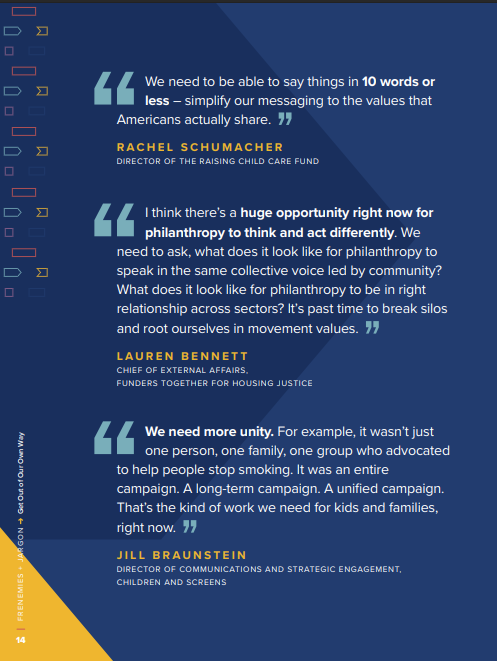
When working in a community, find what you agree on first. Knowing what you have in common with your peers helps you stay focused on the most important work without getting hung up on unnecessary details that may stall progress.
Again, be willing to compromise. Ask: how can we collaborate with a so-called competitor where we’ve historically gotten stuck?
Share your resources. We’re seeing nonprofits come together in unique ways, sharing funding, office space, printer paper and acting as one.
We know the problem – now, it’s time to do something about it!
We see our Frenemies + Jargon report, and these ideas, as a starting place. We want to use our findings to strengthen our field and make change happen.
Have an idea of how we can better collaborate? Have you seen this in your own work? We’d love to hear about it. Just hit reply to this email, and it will land straight in my inbox.
Now let’s go do this thing.
-
Niki is a senior communications strategist with over a decade of specialized experience executing child and family advocacy campaigns. Backed by a Master’s Degree in communications and public relations, her career spans high-impact roles from managing major D.C. policy initiatives at the Children’s Law Center to directing national advocacy accounts. As a lead strategist at Forthright Advising, Niki has pioneered coalition-building trainings and communications strategies for 20+ major child advocacy organizations. She designed and launched the qualitative study behind the Frenemies + Jargon report to help modern nonprofits bypass competition, master smart compromises and build authentic, field-wide collaborations that move policy forward.
Additional Resources
Forthright blog: Calling coalitions: 3 steps to advocate effectively
Forthright blog: How to get people to remember your message
Journal of Nonprofit Innovation: Leading Nonprofit Success Through Collaboration and Partnerships
National Library of Medicine: Collaboration, Competition, and Co-opetition: Interorganizational Dynamics Between Private Child Welfare Agencies and Child Serving Sectors