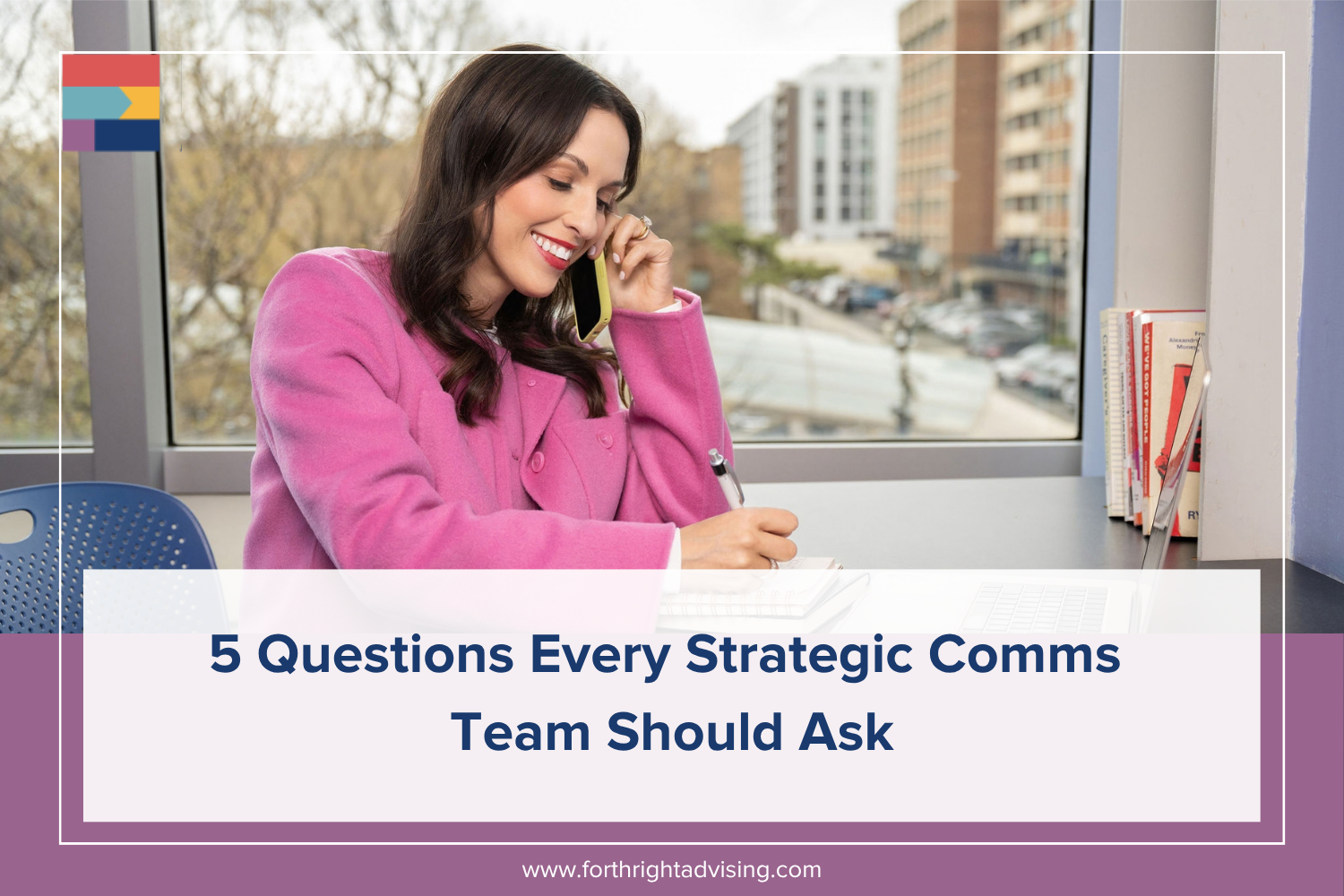
5 Questions Every Strategic Comms Team Should Ask
-
In strategic communications, asking smart questions during project kickoffs is the fastest way to check assumptions, build team alignment, and establish psychological safety. Drawing from an early career blunder, Forthright Senior Leader Zoe shows how replacing fear with curiosity transforms team collaboration and shares four essential kickoff questions that eliminate jargon, uncover hidden project history, and ensure complete clarity before execution begins.
I have a short, cautionary tale brought to you by my early-career mistakes. Here’s what’s in it for you:
My blunder is your happy guide to modeling a culture where asking great questions empowers everyone and makes your work better.
You don’t know what you don’t know
Early in my career in the U.S. Senate, I got a call from another Senate office asking my boss to sign onto important legislation.
Having just transitioned from press to policy, it was the first time I’d gotten a cosign request. My boss had supported the bill in the past, it aligned to her priorities and reflected her community’s values, too.
There was just one teeny tiny problem… I didn’t know what to do next.
I didn’t have a direct manager. I didn’t have any examples or guidance or options for draft feedback. I’d never filled out co-sponsorship paperwork before.
Did I ask for help? Nah. Did I pause and sit in it with my colleagues? Nope.
I decided that everyone expected everyone, including me, to magically know what to do. I worried that asking basic questions would make me feel… silly. Or, worse, that it would be irritating to my colleagues, who always seemed very sure, super important and extra busy.
I felt intimidated and also ambitious. What a fun combination! What could possibly go wrong?
And so, despite the information vacuum I’d stuck myself in, I moved right along and drafted up the paperwork alone.
Predictably, the draft I turned in to my boss was what my colleague Niki might call a “dumpster fire.”
To put the fire out, I had to both change my mindset and start all the way over. I got back on the phone and asked all the basic questions. I put on my comms hat and asked all the strategic questions, too. I considered why this bill mattered right now and what it meant for all the communities we served.
I’d miscalculated the value of curiosity in all of this. I worked without clarity.
It was a tough lesson – and it continues to shape my entire approach to advocacy work.

The right questions show care
These days, I love when I have questions. Even (or especially) as a senior leader, I always get a little burst of excitement getting to say, “I don't know.”
It’s like a cue to be extra curious or take a step back. I’ve learned that that little shift in perspective can give a team and whatever project you’re working on exactly what it needs.
Asking questions shows care and humility. They help us get underneath the surface and understand our work on a deep level, together. That means a working environment that feels compassionate, safe and full of shared wisdom.
By all means, take initiative first. But, both as a supportive teammate and a leader, it’s worthwhile to take a minute to ask burning questions and stay open to learning as you go. That’s literally the whole dang point isn’t it?

So, how do we actually do this in our work?
When we launch new projects with clients (with our snazzy custom project kickoff process), my favorite part is asking questions that check our assumptions, uncover history and push on the why.
Here are five simple questions we love asking:
Why is this your priority right now, and how is this project tied to your overall organizational goals?
This is a biggie. It’s pretty easy to overlook all the organizational context and competing priorities you’re working around.
You’re looking for the big picture. You’re looking to understand your team’s headspace and capacity, too.
Have you tried anything similar before? What has or hasn’t worked in the past?
You’re looking for the backstory you didn’t even know you needed.
Knowing what went wrong two years ago clears the way for you to avoid past mistakes and learn a whole lot about what works well for your team, too.
How do you typically build alignment on your team? What barriers can we anticipate?
You’re looking to understand the team’s specific decision-making culture.
What does it mean to build alignment? Where do drafts and decisions get stuck?
You need to know how the team processes information and how close to consensus you need to get for everyone to feel bought-in and included.
When you say [insert jargon], what does that phrase actually mean to you?
A brave and essential question for child and family advocates!
In our field, we throw around a whole lot of buzzwords. They don’t carry the same meaning, convey the same tone or hold the same weight to everyone.
Specificity matters. Go for it.
What do YOU think?
This one’s really simple: Offer your team a moment to reflect and share.
Show humility and create open, safe spaces in every room you're leading.
Talk to anyone on the Forthright team, and they’ll tell you, there’s always a pause after we introduce new work because everyone knows I’m about to pop in with a minimum of two extra questions. (Sorry-ish about making the meetings longer, guys.)
A little patience and a few answers later, and I’m ready to go!
-
Zoe Alexis Whitehorn
Zoe brings over 17 years of experience in strategic communications, advocacy, and policy across the U.S. Senate, leading national foundations, and social-impact nonprofits. Having managed both press and policy on Capitol Hill, she learned firsthand how critical strategic curiosity and asking the right questions are to preventing project missteps and building team alignment. As a strategic comms leader and relentless problem-solver, Zoe uses thoughtful questioning to help mission-driven organizations check assumptions, establish project clarity, and create high-performing, psychologically safe work environments.