3 Easy Call to Action Tips for Your Communications Strategy
Written by katie test davis
What’s in the Blog
Make just one ask: Keep your emails focused on a single call to action so your readers don't get overwhelmed and freeze.
Keep it under 20 seconds: Remove all friction and make it incredibly fast and easy for your audience to take that action.
Repeat yourself often: Give your readers multiple chances to say yes by repeating your single ask throughout your message.
My cats have me trained.
Yeah, you read that right.
THEY trained ME.
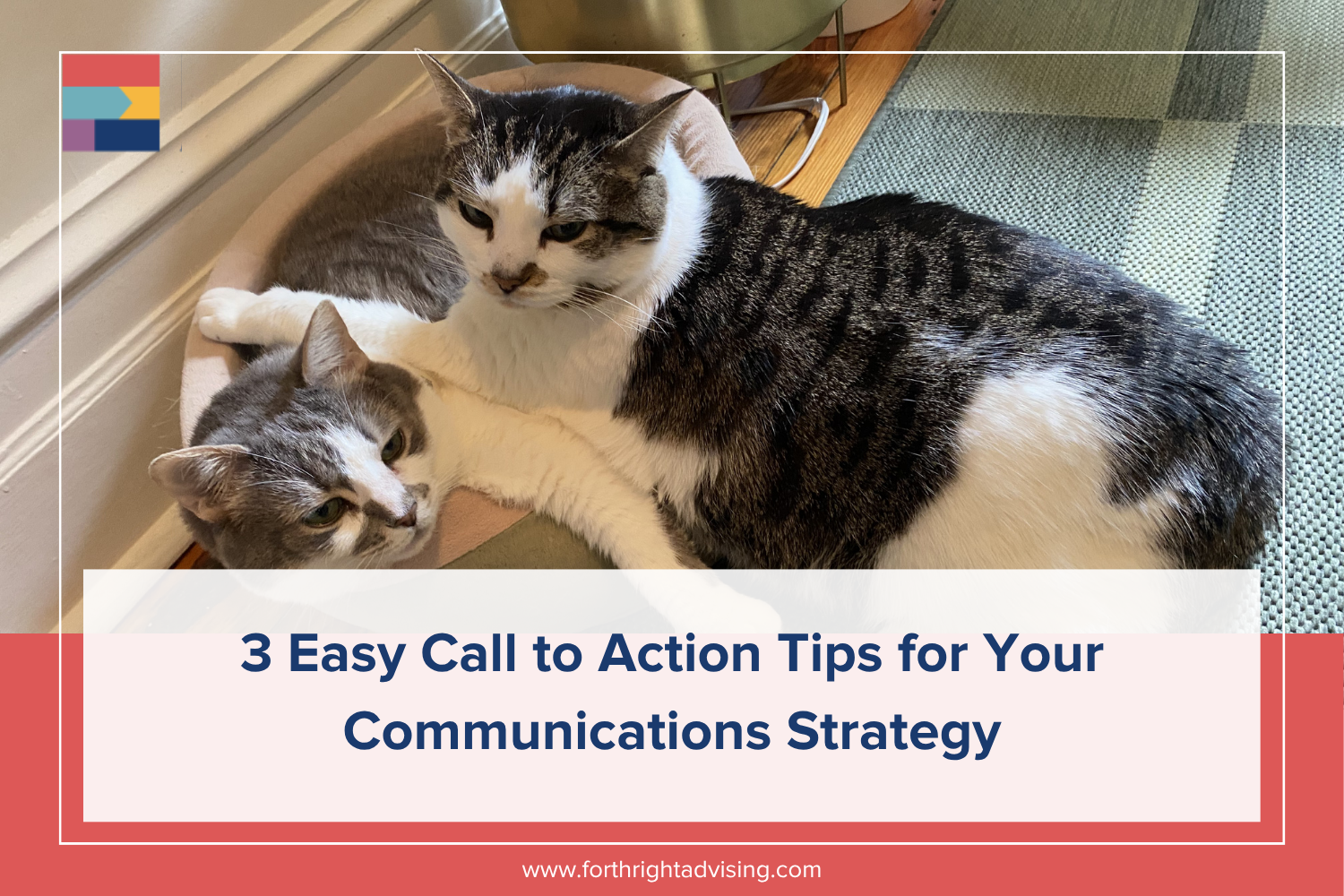
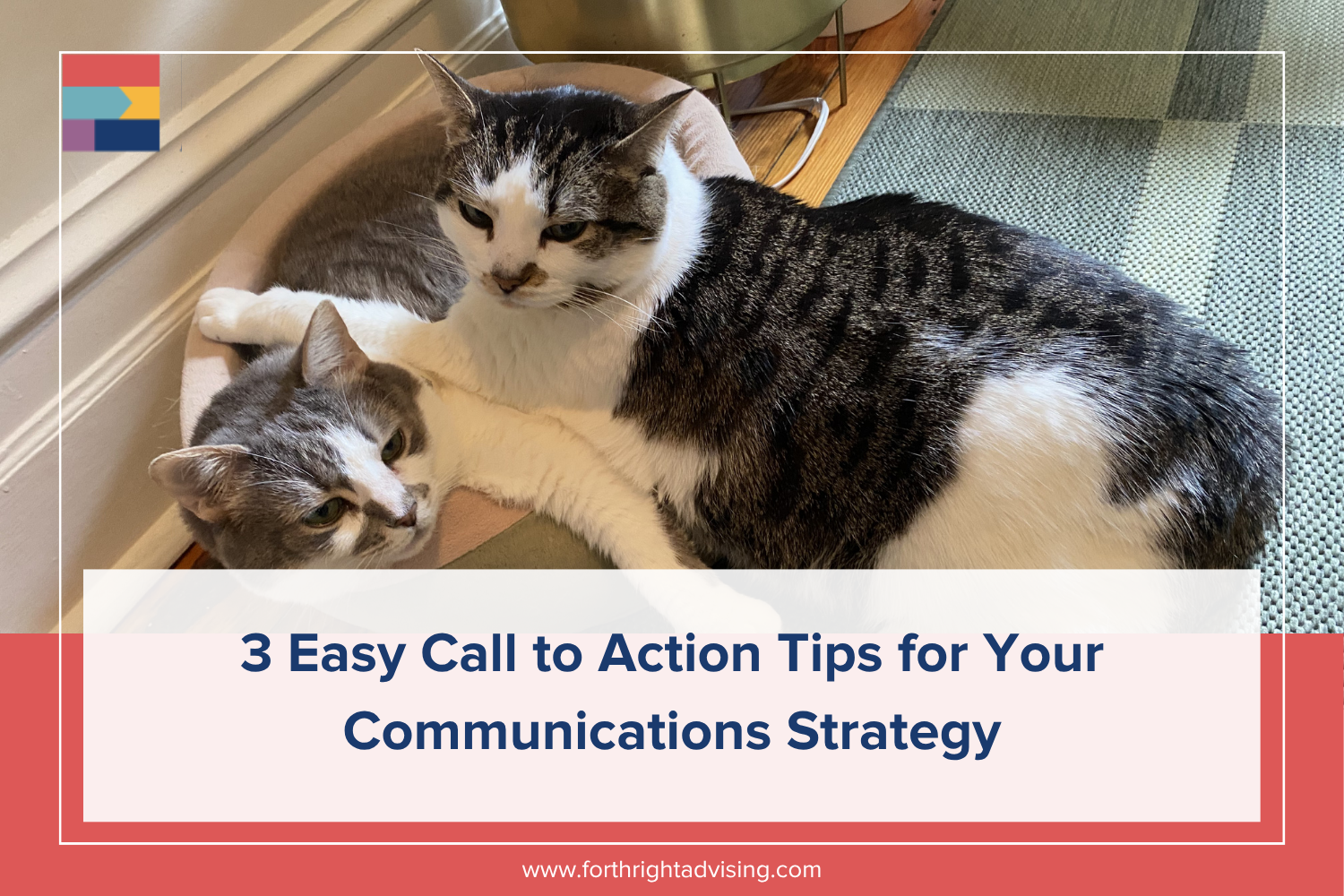
Miko, our shy cat, has a strong preference for me over… well, literally anyone else in the world.
Each morning, she sits near our breakfast table and stares at me, with the occasional chirp meow, until I finish my food and sit on the couch with her for a few minutes before work. If I don’t immediately do this out of habit, she’ll be sure to follow me around, meowing until she can herd me back into the living room for couch time.
Binx, her sister (whose favorite person in the world is my husband, Dan), has also trained both Dan and me (as her spare human) to let her sit on our laps during work meetings. For both of us, she’ll come sit below our desk chair on the right-hand side, wait for us to put a blanket on our lap, then she’ll jump up and get comfy. If we aren’t paying enough attention, she puts both her paws up on our chair and stretch out her spine, in a sort of aerial upward-dog yoga position. It’s enough for us to notice her, and get prepped for her comfort.
Are we suckers? Oh, absolutely. No question.
Yet, there are some very solid communications lessons to be learned from being a human… trained by… a cat.
have one ask
Our clients (nearly) always have a lot of things they want their audiences to do.
Donate.
Partner.
Join.
Purchase.
Subscribe.
Attend.

And at the start of our client partnerships, we (nearly) always find that they’re making too many asks at once. I’ve seen email newsletters with four, five, even seven different actions a reader can take. That causes your audience to get overwhelmed and freeze – taking none of the actions. This was made more famous by Dr. Iyengar’s Jam Study, where the Columbia Business professor studied decision fatigue and choice overload.
The best outreach materials only have one ask, repeated multiple times throughout the materials.
Just like Miko’s singular ask is couch cuddles, you want your audiences to do one thing at a time.
make it fast

There’s a concept in behavioral science called the 20-second rule.
It comes from the Harvard-trained researcher Shawn Achor, in his book The Happiness Advantage.
His work suggests that as humans, we only have a limited supply of willpower.
Because we only have a certain amount of willpower on any given day, our brains naturally default to the path of least resistance.
This applies to any desired action – like starting a workout, practicing an instrument, or if you’re me, doing your physical therapy exercises. If it takes longer than 20 seconds to start, your brain runs out of willpower and energy to do the task.
This is especially true when you’re navigating a clunky website. Or trying to fill out a long form. People will quit, or revert to a lower-effort behavior.
This is CRITICAL information for us communicators to know, because it means we need to design experiences for our clients, customers and even our colleagues, that allow them to do what we want them to do within 20 seconds, and with no friction.

Much like Binx, who is asking us to grab a blanket (which we both, like suckers, store next to our desks just for her) and simply put it on our laps, we’ve got a fast entry and low friction.
repeat it
We talk a lot about repetition at Forthright. If you’ve been here a while, you know that audiences need to hear something seven times to remember it. I argue that in times of stress, that doubles to 14.
Same goes for your calls to action. Make sure that your audience has lots and lots of ways into the action you want them to take.
For example, when we send out an email inviting people to a webinar, we always include at least two buttons in each email, and two text links to the registration page per email. So that’s four ways into the registration page in one email.
Pulling it all together, we make no other ask in the webinar email (no links to follow us on LinkedIn, nothing.) And then we make the registration form quick and easy to fill out (less than 20 seconds).
Much like our cats, you need your one ask to be repeated frequently, in multiple places, and fast to take action on.
Now go out there and cat-ify your strategy. And don’t forget to let us know how it goes!
About the Author
With close to 20 years of experience in public relations for nonprofits and school districts, Forthright Advising Founder Katie Test Davis knows exactly how to move people to action. She is uniquely qualified to write about call-to-action strategies because she has spent her entire career making complex information simple and accessible for our communities. Today, Katie combines her deep empathy for audiences with proven behavioral science to help mission-driven leaders write clear, highly effective emails that get results without overwhelming their readers.