
Two Reasons to Thank Your Donors Today

You know that relative you hear from once a year? For me, it’s a second cousin, Daniel. Like clockwork, he wishes me a Merry Christmas every year...and that’s it.
As a result, I don’t feel close with him—or particularly invested in building our relationship.
That’s what your most important supporters feel like when you only acknowledge and thank them once a year. As we end the holiday season (don’t judge, I was considering Valentine’s Day in that…) and look to a busy spring, it’s important to remember that building relationships with your supporters and partners is critical year-round. We’re including three tips on how to do so here.
SAY THANK YOU FREQUENTLY, WITHOUT AN ASK
The Chronicles of Philanthropy recently compiled a report about how organizations are engaging with supporters during the pandemic—and how supporters are responding. The team found that when an organization reaches out to supporters just to say thank you—without making an ask—supporters feel more connected with the organization, building both future giving (or partnerships!) and their relationship with the nonprofit. For example, one Habitat for Humanity office called donors to simply ask how they were holding up during the pandemic—leading to increased support of the organization.
As you plan your outreach for the rest of the year, consider scheduling thank you calls, postcards or letters (which are highly effective!) and emails throughout the year.
Recognizing your supporters even once a quarter will both build your relationships AND help you stand out as a nonprofit.

SHOW YOUR IMPACT AND HOW SUPPORTERS HELP
The Network for Good shares that one of the biggest reasons donors stop giving is because they don’t see your impact—or how their contributions are making a difference. When a supporter shares a donation (or a partner helps you achieve a goal), remember to show them what their partnership means for those you serve.
When you have a big policy win, or reach an important milestone, reach out to supporters to celebrate! This could be as simple as sending an email explaining what you’ve been able to accomplish, and telling your supporters you couldn’t do it without them.
And pro tip, use the word “you” throughout your messaging. That simple tactic helps supporters feel both personally appreciated and seen.
For example, share a message like this: Thanks to YOU, more than 200 students now have the mental health supports they need to thrive.
TEST YOUR AFTER-GIFT SEQUENCE
What happens after a donor presses submit on their gift? (This is our only tip that’s focused just on your donors, not your partners and supporters, too!) Are you showing them they made the right choice by investing in your cause?
One donor recently shared that he was excited to make a big donation, but all he received was a tax bounceback message after—making him feel like the nonprofit didn’t appreciate his generosity. He said he likely wouldn’t donate to the nonprofit again or help promote it. It’s THAT easy to lose a supporter.
Simply ensuring donors receive a personalized thank you message (which can be automated!) within 48 hours makes a huge difference.
Don’t be like my second cousin Daniel. By taking these three important steps, you can ensure that your messaging isn’t lost in the chaos of year-end giving and holiday messaging—and you’re building a strong, long-term relationship with your supporters.
POPULAR POSTS LIKE THIS
My first job after college was at a PR agency.
I was working with – and I’m not sure how else to phrase this – men’s men. Think: veterans starting their own government contracting businesses, construction CEOs, cybersecurity leaders and more. There was plenty of little lady-ing.
But there were also many, many lessons that I’m still using in my career today, 15 years later. I’m including one of my favorites, and some additional best practices, below.

You know those days where you just want someone to tell you where we're going to dinner?
Sometimes, I get really tired of making decisions – partly because as busy leaders, we make decisions at work all day, every day.
We ask questions such as:
Should we complete this grant application?
Which events should we go to?
Is that conference worth it?
And sometimes, your teammates don’t agree on the answer.
That’s why at Forthright, we use – you guessed it – a data-backed approach to make these decisions.
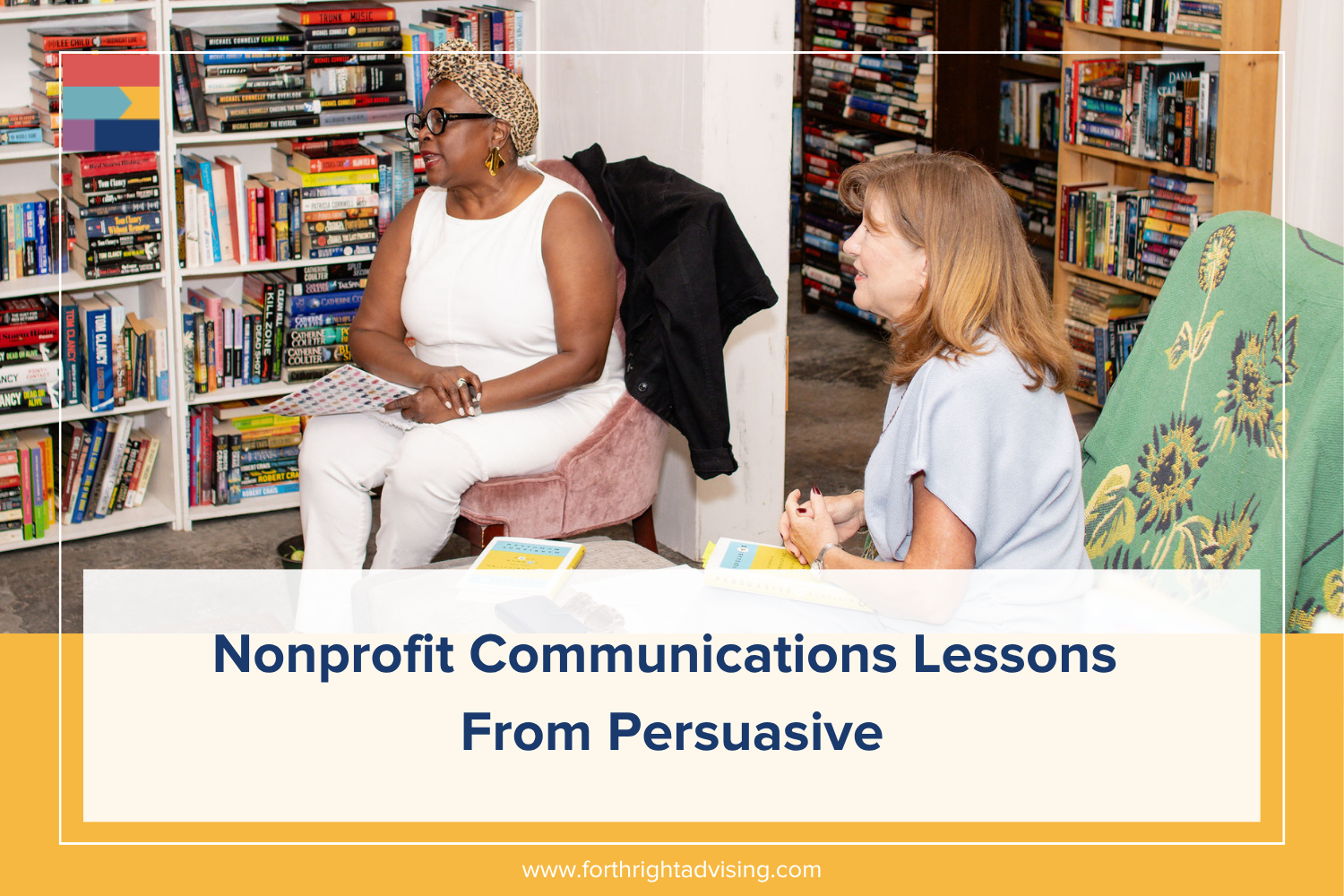
In our world of child and family advocacy, few communicators have navigated the trenches quite like Marrianne McMullen.
From managing high-stakes crises in the Obama administration to shaping narratives at DC Public Schools – where I had the immense privilege of working for her – Marrianne has spent her career masterfully championing policies that support children and families. Today, she serves as the Director of Communication & Dissemination at Chapin Hall, an independent research and policy center focused on child and family well-being.
To celebrate the two-year anniversary of her book, Persuasive, I sat down with my former boss and mentor to reflect on what it takes to effectively move the needle.

When I say the word hope, I can hear some of you out there sighing through the internet tubes. And honestly, fair enough. In our field right now, hope can sometimes get packaged up like a vague platitude or a promise that misses the point.
But, hear me out. Today, I’m talking about the kind of hope that’s fierce and very, very practical.
Data consistently tells us that messaging has to trigger a sense of hope if you want to make sure your audiences don’t default to defensiveness.
Age gaps exist all across the organization.
From your eager intern to your seasoned board members (and your program staff to your executive director), you're likely communicating across up to 40 years of generational differences.
Here are some tips and tricks to help you stay aligned.
When we launched our research process – the one that led to our new Frenemies + Jargon: Breaking the Habits That Stall Child and Family Advocacy report – I had suspicions about what we’d find.
We heard that as a field, we’re often fake friends.
Let’s break down what we heard and what we can do about it.
Our average coaching client is a communications director. For the sake of this blog, let’s call her Chloe.
Chloe typically works at a public school district, a foundation or a nonprofit.
She landed in her director role coming from the policy, program or development team. She may only have a few years of direct communications experience, but she’s a natural.
Most of the time, she’s a team of one, and she’s carrying everything communications for her organization.
That’s where we step in as a coach.
Here’s a behind-the-scenes peek at what we normally help out with.
So, you need to tell your board of directors or your school board some bad news.
First, blerg. Sorry about that!
Second, we’re here to help.
I've had the opportunity to be involved in some excellent examples of how to do this well – and, unfortunately, I’ve also had to help clean up a few, um… shall we say, less-than-stellar attempts.
Here is a key approach that I’ve seen work well over the years.

We know that right now, the families you serve, the partners you need, the funders you want to attract and the policymakers who need to know your work have completely changed how they use the internet.
The way they use conversational search on platforms like ChatGPT, Google's AI Overviews, and Gemini means we simply need to make sure your organization is the trusted AI citation your audiences find.
My cats have me trained.
Yeah, you read that right.
THEY trained ME.
Are we suckers? Oh, absolutely. No question.
Yet, there are some very solid communications lessons to be learned from being a human… trained by… a cat. Here’s what we can all learn.
We’re so used to chasing perfect. Perfection in our work, presenting the perfect image online.
But the thing is, people are tired of perfect. And that needs to impact the way we do our work and the way we advocate. Here’s what’s going on – and what to do about it.
I’m the first to admit it: I’m a nerd for data.
If something is going wrong – I want to know why, so I can fix it.
If something is going well – I want to know why, so I can keep doing it.
That’s why I love a good communications audit. Here’s why you should join me in my nerd-dom and hop on the communications audit train.
An organization (yours, in fact) needs a succinct and centralized set of messages that say what the organization does and how you do it.
When done well, core messages are data-backed ways to describe your work that everyone uses when they talk about your organization.
They typically tell a cohesive story about your organization. You’ll want them to include why you exist (what needs are you fulfilling?), what your mission and vision are, and how you accomplish them.
We’re sharing more about core messaging and how to get it right here.
A couple of weeks ago, I put on my voting shirt (yes, I have one) and headed to vote in Virginia’s special election.
Leading up to the vote, I got So. Many. Campaign. Messages.
The problem? Most of them were unconvincing. It made me think about just how important special elections and bond campaigns are.
That’s why today, I’m sharing best practices about what’s working right now for special elections and bond campaigns.
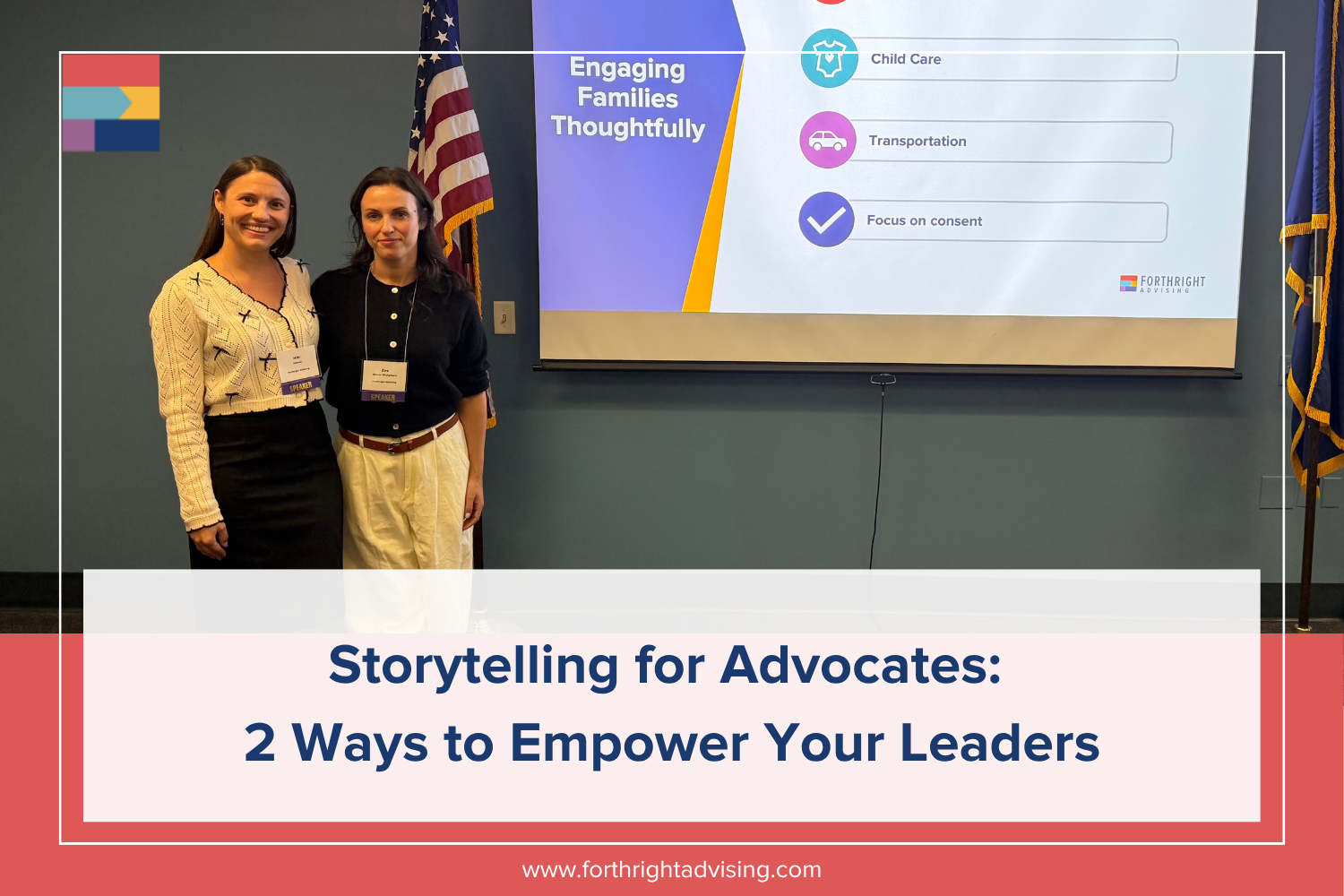
A couple of weeks ago, Zoe and I presented at the Pennsylvania Family Leadership conference. They invited us to speak about the power of storytelling. We walked through how storytelling can make a difference, best practices for setting up (or expanding!) a storytelling program and how to create smart storytelling practices.
We focused on how to ensure family leaders have what they need to succeed in storytelling. One family leader mentioned that while she has shared her story dozens of times, only one nonprofit ever truly prepared her.
That’s why I’m sharing some of our tips below!
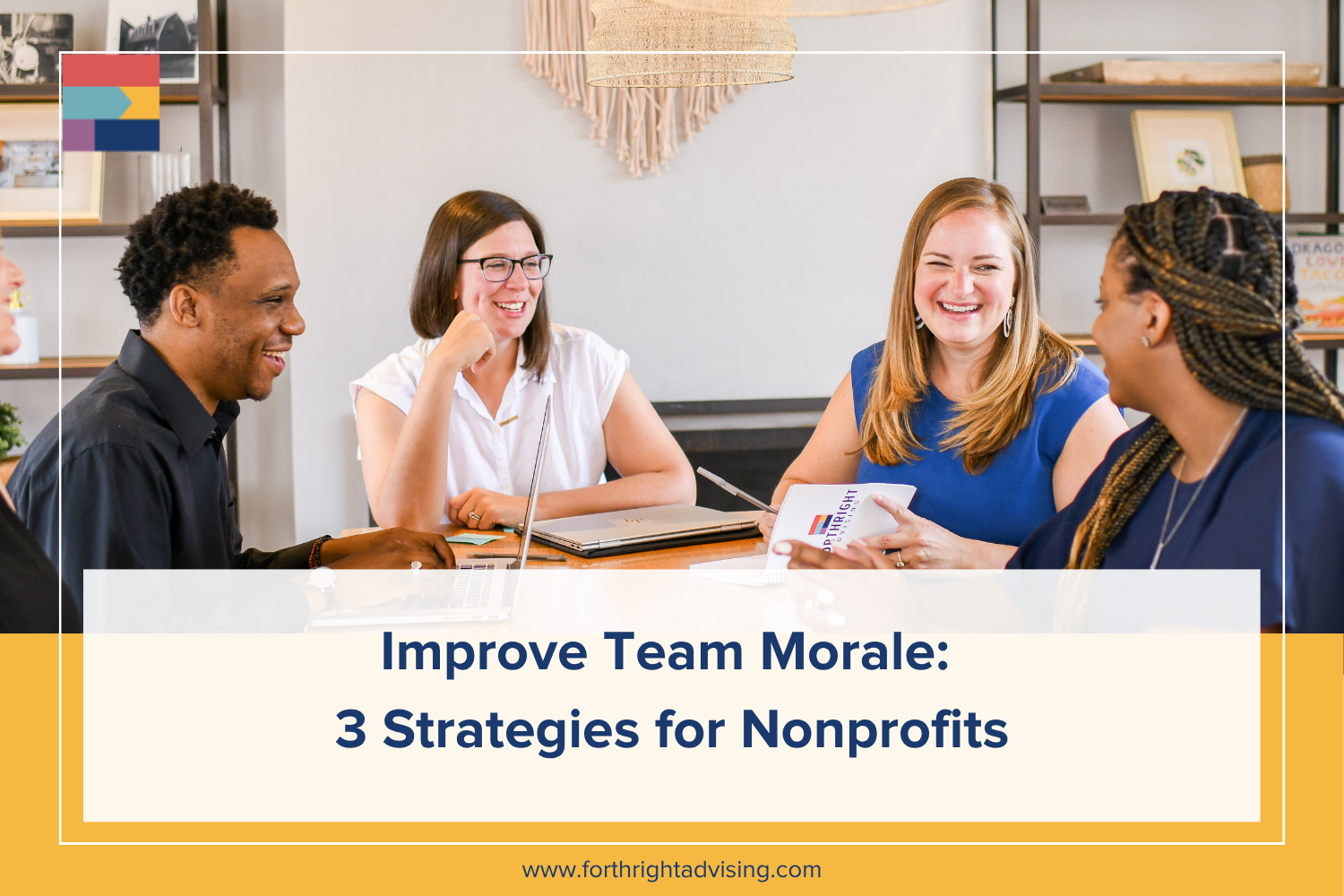
Your team is working really hard. You know what? I’ll say it. Too hard. They’re surrounded by uncertainty, harm and crises. You’re facing staffing changes. (And we’re seeing an unprecedented spike in leadership turnover, too.) The landscape you’re working in is constantly evolving. It’s so easy for your team morale to take a hit when just one of these things occur.
But when all of them are happening all at once? It’s time to focus on improving your team morale.
You want your team to feel energized and hopeful, knowing their vital role contributes to the bigger picture.
How? Well, here are a few morale-boosters workshops we have hosted for various teams (including our own):
Today, it isn’t good enough to just throw your information up on the web and make sure it has the keywords you know your audience searches for.
Instead, you need to intentionally lay out information so that it appears in AI search summaries (like Google's AI overviews) and comes up in the right AI search answers. Recent research from UPCEA shows generative AI tools like ChatGPT, Gemini and Google's AI Overviews shape how people gather information, verify details and form opinions.
You pour massive energy into creating beautiful, data-rich resources for your campaigns. It’s heartbreaking when those tools do not reach the families and policymakers who need them most.
So… let’s fix that, shall we?
Thinking about speaking at a conference? It’s one of the best ways to build your organization’s brand and share your expertise.
But getting your session idea accepted can feel like a total mystery.
That’s what we’re here for.
This is your simple, four-step guide to help you find the right conference and write a proposal that gets a big, enthusiastic YES.

As part of our client partnerships, we conduct research. This looks like stakeholder interviews, surveys, full communications audits… you name it, we’ve likely done it.
Every now and again, we see a trend emerging. And this is one of those times. Over the past couple of years, we’ve heard more and more about the power of personal relationships.
Here’s what we’ve learned – and what to do about it.

We all want to do our best work. But our brains have a literal limit on how much fuel they have for deep thinking. When we’re always on, constantly distracted or simply switching tasks, we slow ourselves down and drain our energy... fast. For example, research from the University of Chicago found that just having a smartphone nearby reduces our “available cognitive capacity.”
That’s precious brain space we’re wasting. As child and family advocates, we don’t have that kind of energy to spare right now.
Let’s protect our headspace instead.
Here’s how.
News breaks.
Funding is cancelled.
New legislation is enacted.
How do communicators like you find steady ground while everything feels like an earthquake?
We get it. It’s a lot.
Yet charting a stable course on unsteady ground is something we’re pretty darn good at here at Forthright. (In fact, we have data to prove it. We heard from our clients in our 2025 client happiness survey that we’re a shelter in the storm.)
So how do we do it? Let’s break it down.

You have a meeting with your board in an hour. You’re presenting at a conference in a month. Your executive director has a local news interview tomorrow.
And you’re staring at a blank page, trying to figure out how to condense years of work into a three-minute segment.
Talking points help you bridge that big-picture vision (the deep work! the passion!) with the specific moment you’re in, the audience you’re talking to and your goals.
Here’s how we do it.
Too often, we overlook the people who already know us, love us, and can help us accomplish our goals.
It takes an intentional plan to mobilize these champions. As always, we’ve got you.
We’ve included your step-by-step guide for activating your champions at every phase of your campaign below!