Forthright Advising
Home Your Team Clients
Subscribe
About Us Equity Commitment Our Methodology Core Values
Services Overview Hiring + Recruiting Branding & Materials Creation Strategic Communications Planning Campaigns Messaging Training Team Capacity Building Digital & Social Media Marketing Research Communications Audits Interim Communications Director
Contact Us Jobs
Home About Us About Us Equity Commitment Our Methodology Core Values Resources Your Team Services Services Overview Hiring + Recruiting Branding & Materials Creation Strategic Communications Planning Campaigns Messaging Training Team Capacity Building Digital & Social Media Marketing Research Communications Audits Interim Communications Director Clients Contact Us Contact Us Jobs
Forthright Advising
Smart communications strategies for organizations that love kids.
Subscribe

How we create account teams for our clients
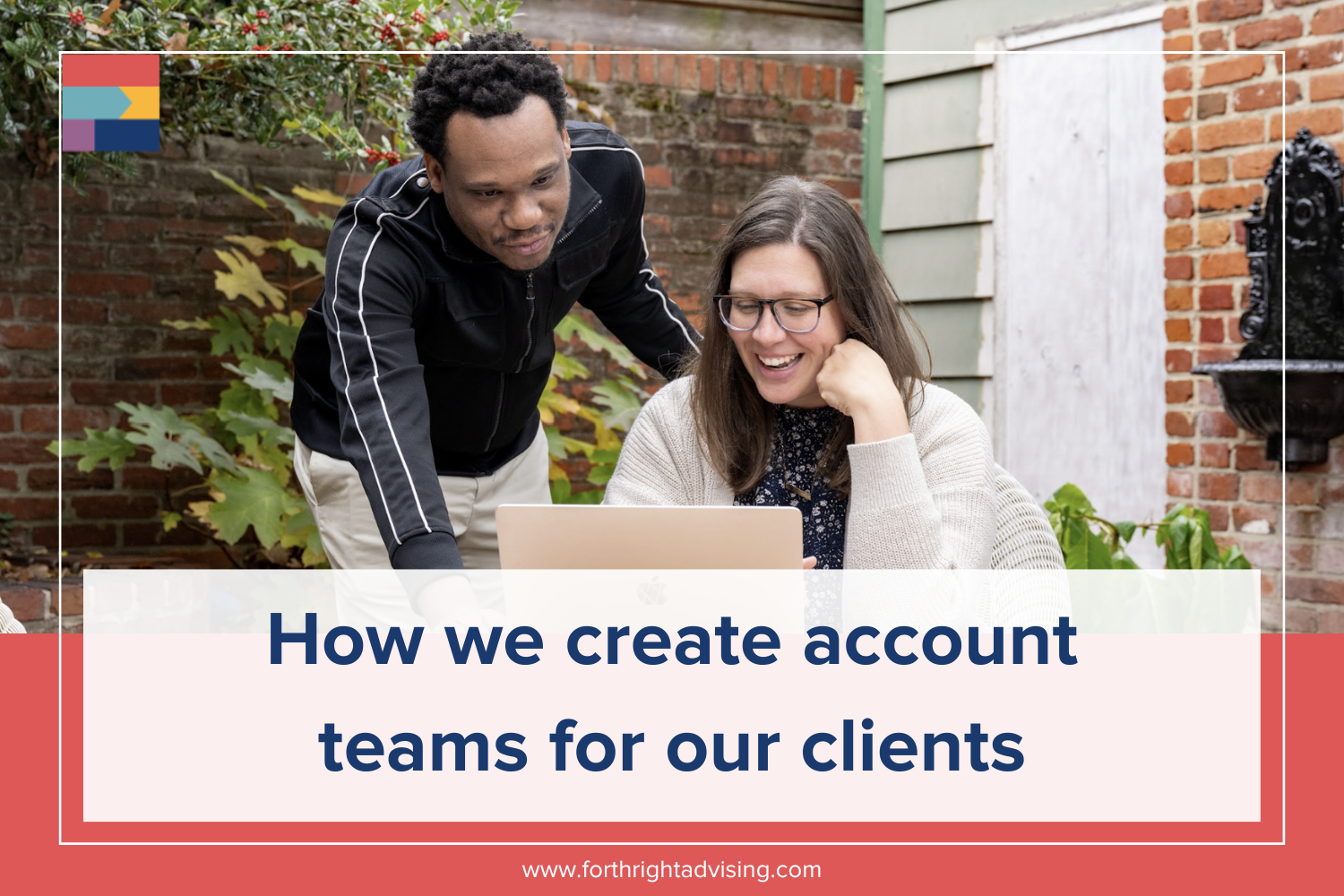
Forthright team members Michael and Lauren work together on a laptop outside.

Written by KATIE TEST DAVIS

One of the most common questions I get when a potential client reaches out about a project is: who am I going to work with? 

So today I’m pulling back the curtain on how we put together a team for a client account. 

First, let’s get to know some Forthright terminology, and understand the typical account team structure: 

  1. Account Lead: At Forthright, the “account lead” will be the client's day-to-day point of contact. They will quickly become your go-to person, and they’ll be the teammate you’ll interact with most. They’ll send you regular project status updates, set meeting agendas and generally keep the trains running on time. I work closely with every account lead across the agency to make sure our clients are getting exactly what they need from us.

  2. Support Teammates: At Forthright, we never send any client deliverable without at least two sets of eyeballs on a document. This not only ensures we provide high-quality work, it also allows us to uphold our first core value of People First, because it empowers teammates to work together on tasks. Personally, I love this about Forthright because it helps when one of us needs to be out unexpectedly (to rest when we’re sick) or on purpose (vacation!). This means that most accounts will have at least an Account Lead and one Support Teammate. Support teammates can also be creatives – so, for example, the graphic designers, web designers or videographers that are contributing to the client project.

  3. Relationship Manager: Usually me, we designed the relationship manager role to keep a high-level perspective on the account and provide back-up support to the Account Lead. The relationship manager pops into your meetings from time to time, and you’ll likely see them when something feels tricky, or you’re making big decisions.


Sign up for our email newsletter to receive all of our best ideas, straight to your inbox

SIGN ME UP

Here’s what this structure looks like in a hierarchy model (though we promise the reality is much more collaborative and easy-going!): 

So, how do we know who will fill each of these roles on specific client accounts? Well, that depends on a few factors.

First, we consider what the account topic is, and we match our teammates’ passion points with the potential project. Luckily, we are an agency focused exclusively on issues impacting children and families. That means if we’re going to accept a project, we almost certainly have some DEEP expertise and passion for the issue at hand.

But we do have certain teammates who have slightly more experience in early childhood than K12, and/or teammates who have worked with the foster care system, or advocated on Capitol Hill. So we’ll take expertise and passion into account first.

Savvy tactics, new ideas.

Sign up with your email address to receive all of our best ideas, straight to your inbox.

We’re all about privacy! When you subscribe, your email stays with us. Period.

Thank you!

Second, we think about the deliverables for the project. We’ll assemble the necessary creative teammates for you, and make sure that the account lead has experience in leading a similar project. Our very first core value is People First, so we make sure that every person in every seat on your team has the time and mental capacity to ensure your project has their full brains. (Psst, that’s why we charge more for work we perform outside of business hours. You can read more about that here.) 

Unlike some of the big-boy agencies out there, our teammates don’t have quotas to meet or targets they are measured on each week. This breathing room allows us to ensure that our teammates are bright-eyed and bushy-tailed for your project. 

Finally, we look for client-team chemistry. Some clients are no-nonsense, know exactly what they want and are ready to rock. An account lead who is a super star project manager and can fast-track projects will best serve this client. Other partners have a more ambiguous problem they want to solve, or need more thought partnership to find the right path forward. A counselor who embodies the “advising” part of Forthright Advising will best serve them. Typically clients are a hybrid of both, and we’ve got teammates who can do both effortlessly. 

No matter what you need, we want to make sure that the teammates we staff on the account are a good personality fit so we are meeting you where you are. (And honestly, part of chemistry is having fun! In our most recent client survey, 100 percent of our clients strong agreed we are fun to work with. So expect to develop some inside jokes along the way…) 

So as you can see, at Forthright, creating a client team is an art, not a science. Instead of letting a computer algorithm compile a random team of staff members who happen to have time right now, at Forthright, a ton of thoughtfulness and strategy goes into creating the perfect client team. (Afterall, happy teammates mean happy clients, so we have a serious stake in the game of getting each client team right.)  

Ready to see what kind of account team we’d be able to create for you and your project? Reach out now for a free strategic consultation.

POPULAR POSTS LIKE THIS
Forthright Advises
Inclusive Leadership Language: Why Word Choice Matters

My first job after college was at a PR agency.

I was working with – and I’m not sure how else to phrase this – men’s men. Think: veterans starting their own government contracting businesses, construction CEOs, cybersecurity leaders and more. There was plenty of little lady-ing. 

But there were also many, many lessons that I’m still using in my career today, 15 years later. I’m including one of my favorites, and some additional best practices, below.

Read more →
Beat Decision Fatigue With a Simple Scoring Matrix

You know those days where you just want someone to tell you where we're going to dinner? 

Sometimes, I get really tired of making decisions – partly because as busy leaders, we make decisions at work all day, every day.

We ask questions such as:

  • Should we complete this grant application? 

  • Which events should we go to? 

  • Is that conference worth it?

And sometimes, your teammates don’t agree on the answer. 

That’s why at Forthright, we use – you guessed it – a data-backed approach to make these decisions.

Read more →
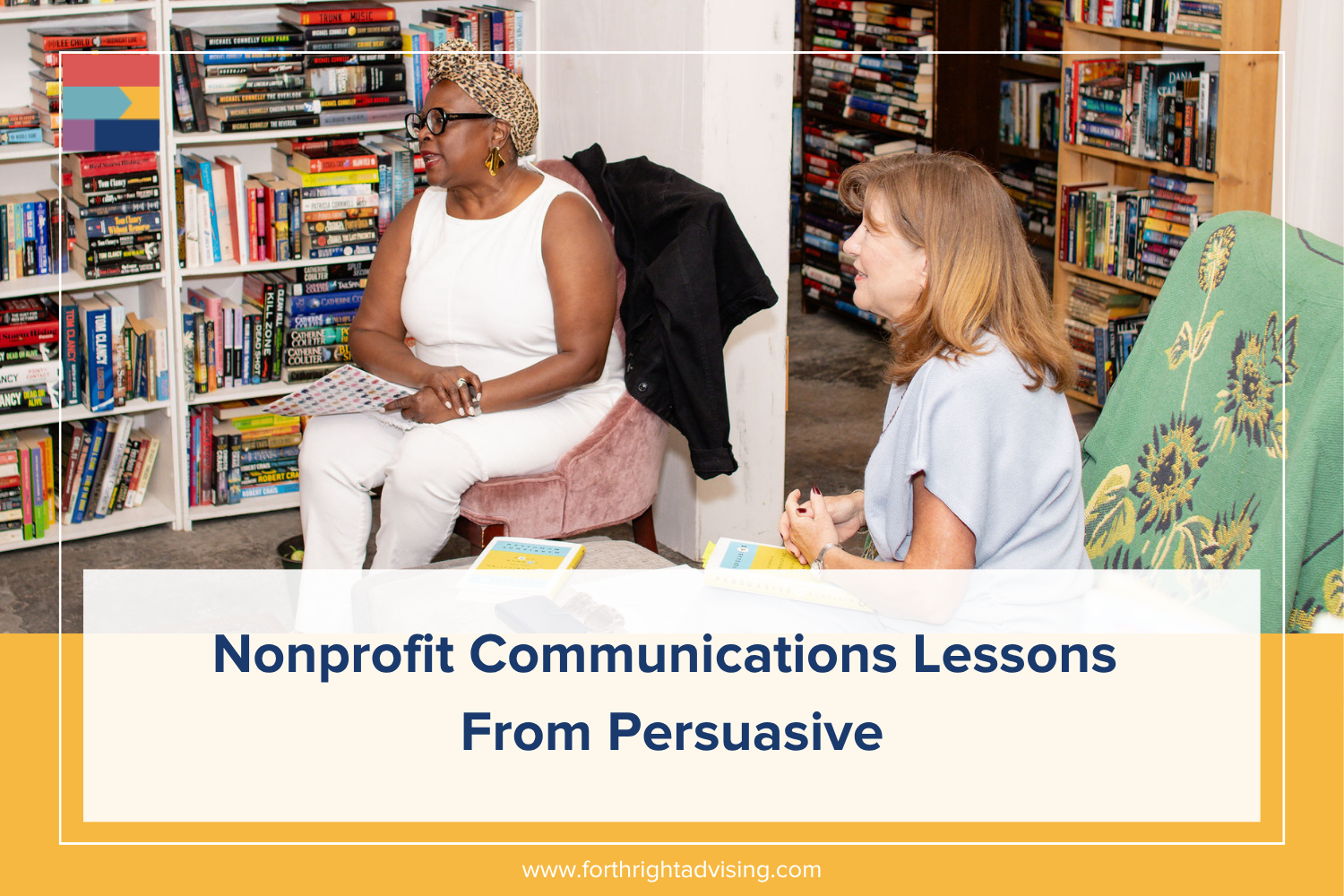
Nonprofit Communications Lessons From Persuasive

In our world of child and family advocacy, few communicators have navigated the trenches quite like Marrianne McMullen. 

From managing high-stakes crises in the Obama administration to shaping narratives at DC Public Schools – where I had the immense privilege of working for her – Marrianne has spent her career masterfully championing policies that support children and families. Today, she serves as the Director of Communication & Dissemination at Chapin Hall, an independent research and policy center focused on child and family well-being. 

To celebrate the two-year anniversary of her book, Persuasive, I sat down with my former boss and mentor to reflect on what it takes to effectively move the needle.

Read more →
How to Reframe Crisis Messaging to Inspire Action

When I say the word hope, I can hear some of you out there sighing through the internet tubes. And honestly, fair enough. In our field right now, hope can sometimes get packaged up like a vague platitude or a promise that misses the point. 

But, hear me out. Today, I’m talking about the kind of hope that’s fierce and very, very practical. 

Data consistently tells us that messaging has to trigger a sense of hope if you want to make sure your audiences don’t default to defensiveness.  

Read more →
Intergenerational Workplace Comms: 3 Tips to Connect

Age gaps exist all across the organization. 

From your eager intern to your seasoned board members (and your program staff to your executive director), you're likely communicating across up to 40 years of generational differences. 

Here are some tips and tricks to help you stay aligned.

Read more →
Child Advocacy Collaboration: How to Stop Stalling Progress

When we launched our research process – the one that led to our new Frenemies + Jargon: Breaking the Habits That Stall Child and Family Advocacy report – I had suspicions about what we’d find.

We heard that as a field, we’re often fake friends. 

Let’s break down what we heard and what we can do about it.

Read more →
3 Ways to Help Your Busy Communications Director

Our average coaching client is a communications director. For the sake of this blog, let’s call her Chloe.

Chloe typically works at a public school district, a foundation or a nonprofit. 

She landed in her director role coming from the policy, program or development team. She may only have a few years of direct communications experience, but she’s a natural. 

Most of the time, she’s a team of one, and she’s carrying everything communications for her organization. 

That’s where we step in as a coach.

Here’s a behind-the-scenes peek at what we normally help out with.

Read more →
Sharing Bad News With Your Nonprofit Board Members

So, you need to tell your board of directors or your school board some bad news.

First, blerg. Sorry about that! 

Second, we’re here to help.

I've had the opportunity to be involved in some excellent examples of how to do this well – and, unfortunately, I’ve also had to help clean up a few, um… shall we say, less-than-stellar attempts.

Here is a key approach that I’ve seen work well over the years. 

Read more →
How to Optimize Your Website for AI Search Engines

We know that right now, the families you serve, the partners you need, the funders you want to attract and the policymakers who need to know your work have completely changed how they use the internet.

The way they use conversational search on platforms like ChatGPT, Google's AI Overviews, and Gemini means we simply need to make sure your organization is the trusted AI citation your audiences find.

Read more →
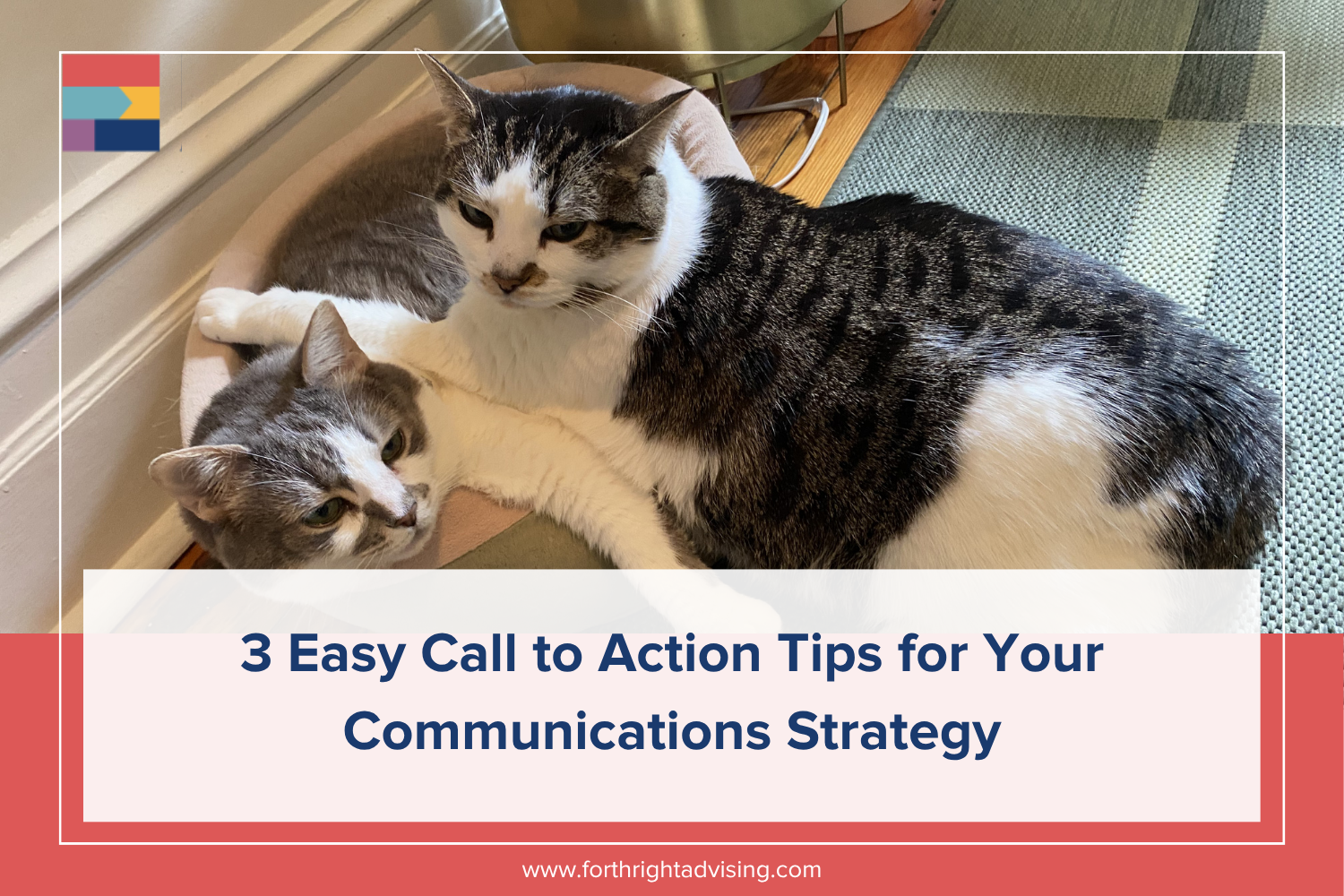
3 Easy Call to Action Tips for Your Communications Strategy

My cats have me trained. 

Yeah, you read that right. 

THEY trained ME. 

Are we suckers? Oh, absolutely. No question.

Yet, there are some very solid communications lessons to be learned from being a human… trained by… a cat. Here’s what we can all learn.

Read more →
How to Build Trust With Authentic, Human Content

We’re so used to chasing perfect. Perfection in our work, presenting the perfect image online.

But the thing is, people are tired of perfect. And that needs to impact the way we do our work and the way we advocate. Here’s what’s going on – and what to do about it. 

Read more →
Communications Audit Guide: How to Optimize Your Strategy

I’m the first to admit it: I’m a nerd for data. 

If something is going wrong – I want to know why, so I can fix it. 

If something is going well – I want to know why, so I can keep doing it. 

That’s why I love a good communications audit. Here’s why you should join me in my nerd-dom and hop on the communications audit train.

Read more →
Core Messaging Guide for Nonprofit Leaders

An organization (yours, in fact) needs a succinct and centralized set of messages that say what the organization does and how you do it. 

When done well, core messages are data-backed ways to describe your work that everyone uses when they talk about your organization. 

They typically tell a cohesive story about your organization. You’ll want them to include why you exist (what needs are you fulfilling?), what your mission and vision are, and how you accomplish them.

We’re sharing more about core messaging and how to get it right here.

Read more →
How to Win Bond Campaigns:  5 Proven Election Strategies
How to Win Bond Campaigns: 5 Proven Election Strategies

A couple of weeks ago, I put on my voting shirt (yes, I have one) and headed to vote in Virginia’s special election.

Leading up to the vote, I got So. Many. Campaign. Messages. 

The problem? Most of them were unconvincing. It made me think about just how important special elections and bond campaigns are. 

That’s why today, I’m sharing best practices about what’s working right now for special elections and bond campaigns. 

Read more →
Leadership Lessons: 8 Years of Nonprofit Communications (Forthright’s Anniversary)

It’s 2026 and I’m wearing a party hat – because today, Forthright officially turns eight years old.

When we learned that the traditional present for an eighth anniversary is pottery, it felt perfect – and it got me thinking about all the connections between my work as a leader and my work as a potter.

I’m sharing more (and celebrating our team and anniversary) here.

Read more →

Nonprofit Communications, About ForthrightKatie Test DavisFebruary 27, 2024creating account teams, Forthright best practices, client work, best PR firms for nonprofits
Twitter LinkedIn0 0 Likes
Previous

Our fave job interview questions for communicators

Nonprofit Communications, Hiring and People, School District MarketingKatie Test DavisFebruary 27, 2024interview questions for communicators, STAR interviewing, communications interviews, public relations interviews, interview questions
Next

Convince your leadership to love comms

Nonprofit Communications, Hiring and People, Communications CampaignsKatie Test DavisFebruary 14, 20242023 reflections, building trust, communications team tips, working with executive team, questions communicators should ask, setting communications goals, communications metrics

About Forthright

→ About Us
→ Your Team

Headquartered in NC, DC and NY - Serving Nationally

No results found

Privacy Policy

For You

→ Resources
→ Blog
→ Client Stories
→ Jobs

Let’s Do This

→ Our Services
→ Contact Us

who we work with:

  • Foundations

  • Child and Family-Focused Organizations

  • Nonprofits

  • Public School Districts

  • Youth Mental Health-Tech Platforms


SWUC_white_PNG.png
Nonprofit-ist-member.Logo.Web.png
A smiling woman in a denim jacket sits at a kitchen counter with a laptop open and a "sign up for our newsletter!" prompt displayed.

Savvy tactics, new ideas.

Straight to your inbox:

We’re all about privacy! When you subscribe, your email stays with us. Period.

Success!


Forthright.Advising.Main.Logo.Web.png

Smart communication strategies for organizations that love kids.