Forthright Advising
Home Your Team Clients
Subscribe
About Us Equity Commitment Our Methodology Core Values
Services Overview Hiring + Recruiting Branding & Materials Creation Strategic Communications Planning Campaigns Messaging Training Team Capacity Building Digital & Social Media Marketing Research Communications Audits Interim Communications Director
Contact Us Jobs
Home About Us About Us Equity Commitment Our Methodology Core Values Resources Your Team Services Services Overview Hiring + Recruiting Branding & Materials Creation Strategic Communications Planning Campaigns Messaging Training Team Capacity Building Digital & Social Media Marketing Research Communications Audits Interim Communications Director Clients Contact Us Contact Us Jobs
Forthright Advising
Smart communications strategies for organizations that love kids.
Subscribe

Eliminating early childhood suspensions: lessons in real-world change

Written by michael ramsey

If you asked me a year ago what came to mind when thinking about early care and education, I would have conjured some pretty traditional images. Toddlers adorned with finger paint. Play-Doh of various colors, sculpted into comically unrecognizable shapes. The joyful sounds of children, with their infectious laughs and with their futures brimming with promise.

You can, then, imagine what it felt to learn more about a startling truth in early care and education in America: the widespread suspensions and expulsions of young children, many barely old enough to walk.

The desire to upend what has become an unfortunate status quo recently led me to Charlotte, North Carolina for the National Black Child Institute’s (NBCDI) national conference. I joined our partners from the North Carolina Coalition for Inclusion, Not Expulsions to talk about the work we’re doing to create a North Carolina where all young children and families have fair and equitable opportunities to fully participate in early care and education settings.

the data: centering equity

Studies show that the greatest predictors of preschool expulsion are the three B’s: “big, Black or boy.” Preschoolers are more likely to be suspended than children in any other grade, with Black children more than twice as likely to be suspended or expelled than other children.

This is an urgent issue that affects all North Carolina communities. According to data from the U.S. Department of Education’s Office of Civil Rights, “47% of children suspended once and 73% of children suspended more than once were Black in 2015-16.” The overwhelming racial disparities in early care and education exclusionary practices make this one of the most significant racial justice issues of our time.

That is why it was so powerful attending the NBCDI national conference and seeing so many experts, activists and community leaders – the vast majority of them Black and people of color – gathered in one place with a single purpose: increasing the quality of life for Black kids.

Two women work on a laptop at an outdoor table, engaging intently with the screen in a garden setting with brick walls and greenery in the background.

Savvy tactics, new ideas.

Sign up with your email address to receive all of our best ideas, straight to your inbox.

We’re all about privacy! When you subscribe, your email stays with us. Period.

Thank you!

Sign up for our email newsletter to receive all of our best ideas, straight to your inbox

SIGN ME UP

the power of collaboration

Over the past year, our team here at Forthright has been partnering with the North Carolina Coalition for Inclusion, Not Expulsions to begin the hard work of eliminating early care and education suspensions and expulsions in the state.

The Coalition includes researchers, care providers, families and advocates with distinct expertise in and experiences across the early childhood field. This collaborative group of partners is committed to identifying the most effective policy and practice solutions needed to create lasting change in the early care and education system.

I joined Coalition Chair Valerie Jarvis McMillan and Coalition member Nina Smith to present at the NBCDI national conference and highlight the Coalition’s progress, as well as the challenges we’ve faced along this journey.

This is a journey we are not taking on alone. The united voices of early care and education professionals, families and policymakers are all essential to change the course. That’s why we’re:

  • working with local organizations and early childhood professionals who are leading work in their communities,

  • incorporating family input and research, and

  • reviewing data on root causes and looking at all the research available on the policies, supports and practices that truly work when it comes to ending the practice of removing children from care.

branding and messaging matter

It is not only imperative that we talk about this issue. How we talk about it matters as well. That’s why one of the first steps in this journey has been solidifying a clear voice for the Coalition.

With this in mind, Forthright was tasked with developing:

  • messaging for the Coalition, empowering us to communicate effectively with key audiences, and

  • developing a brand identity that ensures consistency and clarity in how we present ourselves to the world.

Throughout this process, we strove to be as collaborative as possible while maintaining a laser focus on equitable outcomes for Black children. Together, we created messaging and branding guides, along with a new logo that captures the Coalition’s approach to eliminating racial disparities in early care and education exclusionary practices.

Our presentation at the NBCDI national conference was the culmination of a yearslong effort. It was beyond satisfying to see the Coalition’s visual identity come to life publicly for the first time. There is much work yet to be done, and we're looking forward to our continued partnership with the Coalition to build a better world for North Carolina children and families.

A world where hopefully finger paint, Play-Doh, and inclusivity are once again the defining traits of early care and education.
POPULAR POSTS LIKE THIS
Forthright Advises
Nonprofit Form 990 Public Records: A Guide for Communicators

I am really good at communication. I am TERRIBAD at math. 

Accounting, even for my own business, takes A LOT of focus and explanations for me to understand. My eyes glaze over at spreadsheets. 

I’m telling you this so you believe me when I say that if I’m writing you an entire email about a tax form, it is directly relevant to your communications.

I don’t just dilly dally in tax forms for funsies. No ma’am, no way. But times they are a-changin, and as communicators, we need to tap into the 990 game. 

But let’s start at the beginning, shall we?

Read more →
Audience Engagement Strategies: Why Small Events Work

Have you noticed that people… aren’t reading stuff very closely right now? (Not you, you’re doing a great job reading this blog so far!) 

Do you notice colleagues are more checked out than usual? 

Burnout, compassion fatigue, cognitive overload – you name it, our audiences have it. We’ve got short attention spans, and even shorter fuses. 

So what’s a communicator to do to get attention? Throw a party, of course.

Read more →
How to Ghostwrite for Nonprofit Executives: A 5-Step Guide

While ghostwriting is absolutely one of my favorite projects, it's taken me years to get it right. (Or should I say write?). Today, I'm sharing some of my favorite best practices. 

I’ve ghostwritten for more superintendents, CEOs and leaders than I can count. Here are the steps I never skip. 

And for you CEOs and leaders who are getting ghostwritten for – these same tips apply!

Read more →
Inclusive Leadership Language: Why Word Choice Matters

My first job after college was at a PR agency.

I was working with – and I’m not sure how else to phrase this – men’s men. Think: veterans starting their own government contracting businesses, construction CEOs, cybersecurity leaders and more. There was plenty of little lady-ing. 

But there were also many, many lessons that I’m still using in my career today, 15 years later. I’m including one of my favorites, and some additional best practices, below.

Read more →
Beat Decision Fatigue With a Simple Scoring Matrix

You know those days where you just want someone to tell you where we're going to dinner? 

Sometimes, I get really tired of making decisions – partly because as busy leaders, we make decisions at work all day, every day.

We ask questions such as:

  • Should we complete this grant application? 

  • Which events should we go to? 

  • Is that conference worth it?

And sometimes, your teammates don’t agree on the answer. 

That’s why at Forthright, we use – you guessed it – a data-backed approach to make these decisions.

Read more →
Nonprofit Communications Lessons From Persuasive

In our world of child and family advocacy, few communicators have navigated the trenches quite like Marrianne McMullen. 

From managing high-stakes crises in the Obama administration to shaping narratives at DC Public Schools – where I had the immense privilege of working for her – Marrianne has spent her career masterfully championing policies that support children and families. Today, she serves as the Director of Communication & Dissemination at Chapin Hall, an independent research and policy center focused on child and family well-being. 

To celebrate the two-year anniversary of her book, Persuasive, I sat down with my former boss and mentor to reflect on what it takes to effectively move the needle.

Read more →
How to Reframe Crisis Messaging to Inspire Action

When I say the word hope, I can hear some of you out there sighing through the internet tubes. And honestly, fair enough. In our field right now, hope can sometimes get packaged up like a vague platitude or a promise that misses the point. 

But, hear me out. Today, I’m talking about the kind of hope that’s fierce and very, very practical. 

Data consistently tells us that messaging has to trigger a sense of hope if you want to make sure your audiences don’t default to defensiveness.  

Read more →
Intergenerational Workplace Comms: 3 Tips to Connect

Age gaps exist all across the organization. 

From your eager intern to your seasoned board members (and your program staff to your executive director), you're likely communicating across up to 40 years of generational differences. 

Here are some tips and tricks to help you stay aligned.

Read more →
Child Advocacy Collaboration: How to Stop Stalling Progress

When we launched our research process – the one that led to our new Frenemies + Jargon: Breaking the Habits That Stall Child and Family Advocacy report – I had suspicions about what we’d find.

We heard that as a field, we’re often fake friends. 

Let’s break down what we heard and what we can do about it.

Read more →
3 Ways to Help Your Busy Communications Director

Our average coaching client is a communications director. For the sake of this blog, let’s call her Chloe.

Chloe typically works at a public school district, a foundation or a nonprofit. 

She landed in her director role coming from the policy, program or development team. She may only have a few years of direct communications experience, but she’s a natural. 

Most of the time, she’s a team of one, and she’s carrying everything communications for her organization. 

That’s where we step in as a coach.

Here’s a behind-the-scenes peek at what we normally help out with.

Read more →
Sharing Bad News With Your Nonprofit Board Members

So, you need to tell your board of directors or your school board some bad news.

First, blerg. Sorry about that! 

Second, we’re here to help.

I've had the opportunity to be involved in some excellent examples of how to do this well – and, unfortunately, I’ve also had to help clean up a few, um… shall we say, less-than-stellar attempts.

Here is a key approach that I’ve seen work well over the years. 

Read more →
How to Optimize Your Website for AI Search Engines

We know that right now, the families you serve, the partners you need, the funders you want to attract and the policymakers who need to know your work have completely changed how they use the internet.

The way they use conversational search on platforms like ChatGPT, Google's AI Overviews, and Gemini means we simply need to make sure your organization is the trusted AI citation your audiences find.

Read more →
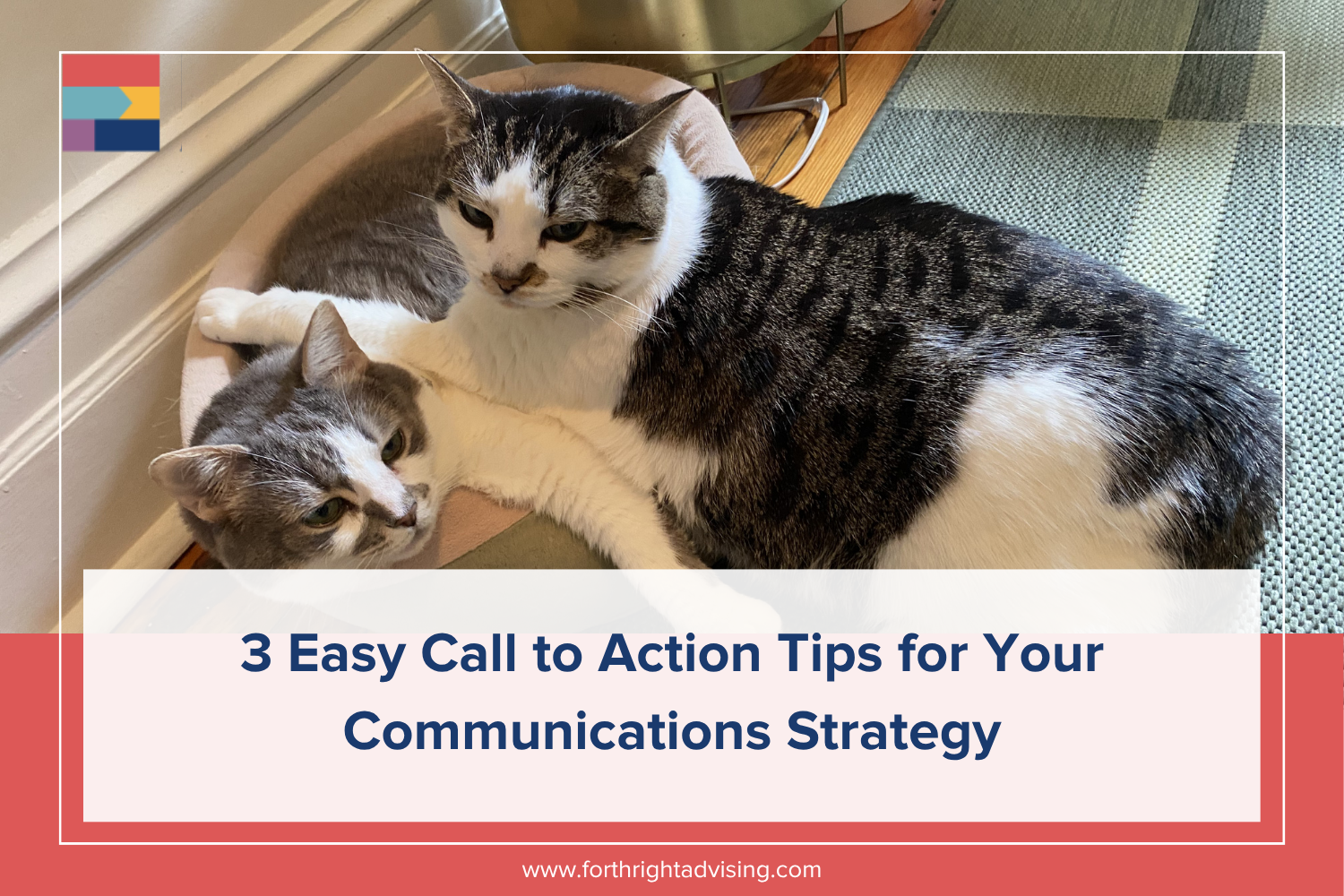
3 Easy Call to Action Tips for Your Communications Strategy

My cats have me trained. 

Yeah, you read that right. 

THEY trained ME. 

Are we suckers? Oh, absolutely. No question.

Yet, there are some very solid communications lessons to be learned from being a human… trained by… a cat. Here’s what we can all learn.

Read more →
How to Build Trust With Authentic, Human Content

We’re so used to chasing perfect. Perfection in our work, presenting the perfect image online.

But the thing is, people are tired of perfect. And that needs to impact the way we do our work and the way we advocate. Here’s what’s going on – and what to do about it. 

Read more →
Communications Audit Guide: How to Optimize Your Strategy

I’m the first to admit it: I’m a nerd for data. 

If something is going wrong – I want to know why, so I can fix it. 

If something is going well – I want to know why, so I can keep doing it. 

That’s why I love a good communications audit. Here’s why you should join me in my nerd-dom and hop on the communications audit train.

Read more →

Nonprofit Communications, Writing and Messaging, Brand/Materials Creation, Communications Campaigns, StorytellingForthright AdvisingDecember 1, 2023elections, equity, Early care and education, branding, messaging, preschool suspension, preschool expulsion, suspensions and expulsions, logo, collaboration, communications campaign
Twitter LinkedIn0 0 Likes
Previous

Our top tip for pitching reporters

Nonprofit Communications, Communications Campaigns, Media Relations, School District MarketingNiki JuhaszDecember 5, 2023media relations, pitching, pitching reporters, journalists, public relations, pitching checklist
Next

5 tips for better project feedback

Nonprofit Communications, Writing and Messaging, Brand/Materials Creation, School District MarketingForthright AdvisingNovember 13, 2023elections, systems, clear communication, advocacy, advocates, feedback, graphic design, writing project, creative project, kickoff call, branding, quality review, creative feedback

About Forthright

→ About Us
→ Your Team

Headquartered in NC, DC and NY - Serving Nationally

No results found

Privacy Policy

For You

→ Resources
→ Blog
→ Client Stories
→ Jobs

Let’s Do This

→ Our Services
→ Contact Us

who we work with:

  • Foundations

  • Child and Family-Focused Organizations

  • Nonprofits

  • Public School Districts

  • Youth Mental Health-Tech Platforms


SWUC_white_PNG.png
Nonprofit-ist-member.Logo.Web.png
A smiling woman in a denim jacket sits at a kitchen counter with a laptop open and a "sign up for our newsletter!" prompt displayed.

Savvy tactics, new ideas.

Straight to your inbox:

We’re all about privacy! When you subscribe, your email stays with us. Period.

Success!


Forthright.Advising.Main.Logo.Web.png

Smart communication strategies for organizations that love kids.